Answer up front
Cutting to the chase: Shut the water off first, at the main house valve or the meter valve if the main will not close. Kill power to the affected area at the breaker panel before standing in water. Open low taps to drain the system, then photograph and video everything before moving or drying anything. Only then start removing water. HomeGuide puts burst pipe repair itself at $400 to $2,000, while the water damage is usually the larger number.
If you only read one paragraph: A burst pipe sequence: shut off the water, kill power safely, drain the system, document for the insurer, and what published burst pipe repair costs show.
The first ten minutes, in order
The order below is deliberate. Every minute of running water adds to the damage, which is why the water comes first, but the electrical step comes before anyone walks into a wet room. Documentation comes before drying, because once belongings are moved and drywall is cut, the evidence of what happened is gone.
- Shut the water off. The main valve is usually where the service line enters the house: a front basement wall facing the street, a utility room, or a crawl space. Turn it clockwise until it stops.
- If that valve will not close or cannot be reached, use the meter valve. A meter key is the right tool, and the pit lid may be heavy and iced over.
- Kill electrical power to the affected area at the breaker panel before stepping into standing water. If the panel itself is in the wet zone, do not approach it.
- Open the lowest taps in the house, inside and outside, so remaining pressurized water drains away from the break instead of through it.
- Switch the water heater off, gas control to off and electric at the breaker, so it cannot fire on a tank that is emptying.
- Photograph and video everything before moving anything: the water level, the source, every affected room and every damaged item.
- Then start extracting water and lifting belongings out of the wet zone.
Know where the shutoff is before you need it
The most common reason a burst pipe becomes a large claim is not the pipe. It is fifteen minutes spent looking for a valve. Find it now, label it, and close and reopen it to confirm it works: a gate valve that has not moved in twenty years frequently will not.
In Colorado housing stock the valve is almost always in one of a small number of places.
- Where the service line enters the building, often on the basement wall facing the street, close to floor level.
- In a utility or mechanical room, near the water heater and any pressure-reducing valve.
- In a crawl space, within a few feet of where the line comes through the foundation.
- At the meter itself, in a pit near the street or on a basement wall depending on the age of the house.
- Individual stops at each toilet, sink and water heater, which are useful for a fixture failure and useless for a burst line inside a wall.
Electrical safety, which is the part that can kill you
Water and live circuits is the only genuinely lethal element of a burst pipe. Everything else is expensive. This step gets skipped because the instinct is to rush toward the water, and that instinct is wrong.
- Turn off the affected circuits at the breaker panel, not at the wall switch.
- If reaching the panel means standing in water, stop and call the electricity provider or an electrician instead.
- Do not plug a shop vacuum, pump or fan into a socket inside the wet area.
- Treat any submerged appliance as finished until an electrician says otherwise, including furnaces, boilers and laundry equipment.
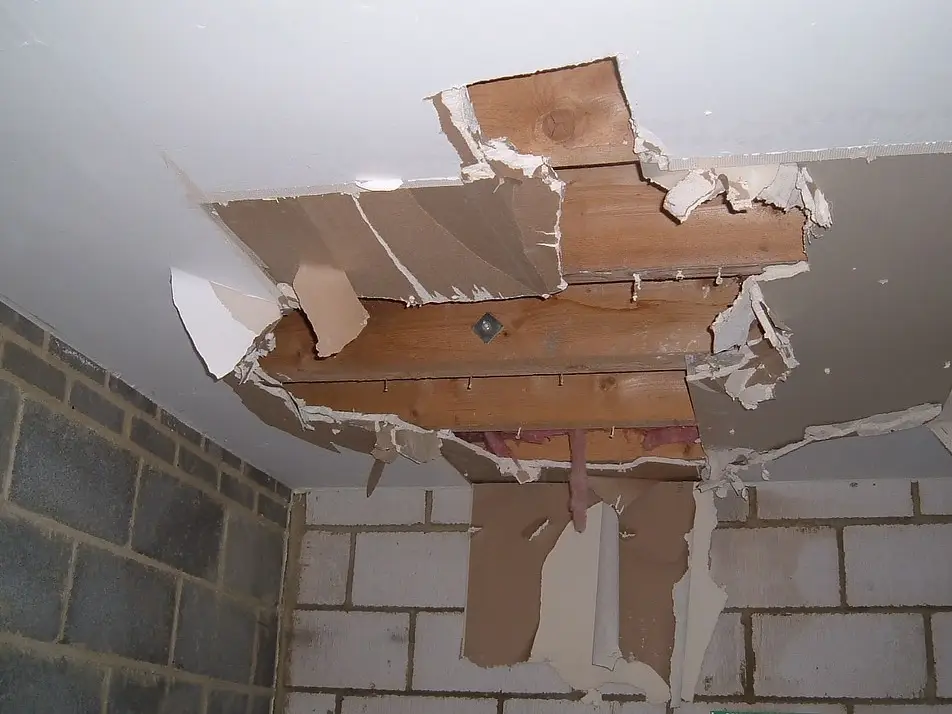
- Water dripping through a ceiling means the light fittings and wiring above are wet. Kill those circuits before touching a switch.
Slowing the damage once the water is off
After the water stops, the clock changes character. The problem is no longer volume, it is time: how long materials stay wet determines whether this is drying and paint or demolition and mold remediation.
The aim is to get water out of the lowest point of the house, get air moving, and get absorbent materials away from structure. What you should not do is start cutting until the damage has been recorded.
- Move water away from the lowest floor first, since that is where it pools and where mechanical equipment usually lives.
- Lift belongings out of the room rather than covering them in place, and get anything paper, fabric or upholstered clear of the floor.
- Pull wet carpet back and lift the underlay, which holds water against the subfloor for days.
- Open interior doors, cabinet bases and toe kicks so trapped air can exchange, and run air movement if it is electrically safe to do so.
- Hold off on removing drywall until the damage is documented and, if a claim is likely, discussed with the insurer.
Documentation, before the cleanup
The evidence disappears fast, and it disappears because of exactly the actions a sensible homeowner takes next. Ten minutes of recording protects the claim, and it also protects against a later argument that the failure was gradual rather than sudden. Insurers commonly treat those two situations differently, which makes the physical evidence of a split worth keeping.
- A video walkthrough with spoken narration of every affected room, recorded before anything is moved.
- Photographs of the failed section of pipe itself, in place, before it is cut out.
- The date and time the problem was discovered, and the time the water was shut off.
- A written inventory of damaged items with rough purchase dates and values, not just photographs.
- Receipts for everything spent on mitigation: pumps, fans, a hotel night, the emergency plumbing invoice.
- The removed section of pipe, kept in a bag. It is physical evidence of a sudden failure.
What not to do
Most of the avoidable cost in a burst pipe comes from a handful of understandable reactions.
- Do not apply a flame to a frozen or burst pipe. Thawing with a torch starts structure fires and destroys the evidence of what failed.
- Do not turn the water back on to check whether it is still leaking. It is.
- Do not throw damaged property away before it has been documented and, if relevant, seen by an adjuster.
- Do not sign a restoration contract you have not read while standing in water at midnight.
- Do not delay notifying the insurer while deciding whether to claim, since most policies impose a duty of prompt notice.
- Do not assume a pipe that froze without splitting is fine. A weakened section can fail weeks later, often at a fitting.
Why freeze-thaw bursts pipes, and where
Water expands as it freezes, but the split is rarely at the ice. Freezing starts at the coldest point and grows an ice plug. Once that plug seals the bore, continued freezing pushes water ahead of it, and because the far end is a closed tap or valve, the pressure has nowhere to go. It climbs until the weakest point in that closed section fails, often several feet from the ice and frequently at a fitting.
That mechanism explains two things homeowners find strange. A pipe can burst while the tap is still frozen shut and produce no water until it thaws, which is why a burst is often discovered days later. And leaving a tap trickling works not because moving water cannot freeze, but because an open tap prevents a closed pressurized section forming at all.
Where it happens
The pattern is consistent: exterior walls on the north and west sides, unheated garages, crawl spaces, attic runs, vented soffits, and any pipe sitting on the cold side of insulation instead of the warm side. Hose bibbs and the short run feeding them are the single most common failure point, particularly where a hose was left connected through a cold night, because the hose holds water at the coldest part of the assembly.
Freeze-thaw rather than deep cold
Repeated cycling between freezing nights and above-freezing days is harder on plumbing than a steady cold spell, which is why Colorado's winters produce failures rather than merely cold pipe. Each cycle moves the ice front, works fittings and finds the weak joint. It also means the damage is usually discovered during the thaw, when the plug melts and a split that formed hours earlier starts to run.
What repair involves, and what published figures show
Two numbers matter and they are not the same: the plumbing repair, usually modest, and the damage, usually not. HomeGuide puts burst pipe repair at $400 to $2,000 including materials and labor, or $150 to $250 per linear foot, with a national average of $1,200 and outliers from $100 to $10,000. The same source lists drywall replacement at $2 to $6 per square foot and mold remediation at $1,500 to $6,000.
For scale on the damage side, the Insurance Information Institute reports an average claim severity of $13,954 for water damage and freezing across 2018 to 2022, and 1.61 claims per 100 house-years, which it describes as about one insured home in 60 filing such a claim in a year. None of these published figures price a specific repair or estimate any particular house. They explain why the urgency is about minutes rather than about the pipe.
| Factor | Why it matters | Typical consequence |
|---|---|---|
| Break location | Exposed pipe, finished wall or slab | Access can exceed the plumbing |
| Pipe material | Copper, steel, CPVC and PEX fail differently | Sections replaced, not patched |
| How long water ran | Minutes versus overnight | Drying, drywall and mold risk |
| One split or several | A run frozen end to end splits repeatedly | Section replacement |
| Why the run froze | Insulation on the wrong side; air leaks | Reroute or insulate, not a repeat repair |
| Local permit | Repiping is permitted locally in Colorado | Adds inspection time |
Stopping the repeat
A pipe that froze once will freeze again in the same place under the same conditions, because the cause is the thermal detail rather than the weather. Repairing the split without addressing why that run got cold is a decision to do this again.
- Disconnect hoses before the first hard freeze and drain each bibb, since a connected hose traps water at the coldest point.
- Specify frost-proof hose bibbs with an interior shutoff when exterior lines are replaced.
- Insulate pipe on the warm side of the cavity and seal the air leak chilling it. Insulation alone around cold pipe just slows the inevitable.
- Open cabinet doors on sinks against exterior walls during a cold snap, and keep the thermostat no lower than 55F when away.
- Label the main valve and exercise it yearly, so it closes when it matters.
- For a house left empty in winter, consider an automatic leak shutoff on the main, or have the system drained.
When to put the wrench down
- Summit Plumbing Match connects Colorado homeowners with independent licensed plumbers for burst pipe and frozen line work.
- The water will not stop, or the main valve will not close, which makes this an immediate call rather than a repair to schedule.
- Water is running through a ceiling, near a panel, or over any electrical equipment.
- The break is inside a wall, under a slab or in a concealed run, so finding it is part of the job.
- A long run froze end to end, which means multiple splits are likely and section replacement is on the table.
How Colorado handles this
Colorado's winters do their damage through repeated freeze-thaw cycling rather than through record cold, and the long heating season means the vulnerable window runs for months rather than weeks. Minimum burial depth for buried water service is set by the local jurisdiction rather than statewide, so confirm the local figure before any service line work. Frost-proof hose bibbs with interior shutoffs are worth specifying rather than assuming, since exterior taps and the short runs feeding them are the most common failure point. Repiping and service line repairs are permitted and inspected locally, even though the plumber's license comes from the Colorado State Plumbing Board. Frozen & Burst Pipes in Colorado is covered in full on its own page, with published ranges on the frozen pipes costs page, and requests from any of the 37 covered markets reach licensed plumbers in Colorado. Local pages include Lafayette and Erie.
Answers first
Frequently asked
What is the very first thing to do when a pipe bursts?
Shut the water off at the main house valve, then kill power to the affected area at the breaker panel before walking into standing water. Those two actions, in that order, determine how bad the rest of it gets. Then open low taps to drain the system, switch off the water heater, and document everything before moving or drying anything.
How much does burst pipe repair cost?
HomeGuide puts burst pipe repair at $400 to $2,000 including materials and labor, or $150 to $250 per linear foot, with a national average of $1,200. The water damage is usually the larger figure: the same source lists mold remediation at $1,500 to $6,000. These are published ranges, not an estimate for a specific property, and access drives most of the variation.
Should I try to thaw a frozen pipe myself?
Gentle warming with a hairdryer or heat lamp on accessible pipe is reasonable, working from the tap end back towards the ice so meltwater has somewhere to go. Never use a torch or open flame. If the pipe runs inside a wall or under a slab, or you cannot see the whole run, stop: thawing a pipe that has already split simply releases the water into the building.
Does insurance cover a burst pipe?
It depends on the policy and on how the loss is characterized. Insurers commonly distinguish sudden and accidental damage from gradual seepage and from damage attributed to a lack of maintenance, and some forms specifically exclude freeze damage where heat was not maintained in an unoccupied dwelling. This is general information rather than insurance advice, so read your own policy and ask the insurer about the exact wording.
Why did the pipe burst somewhere other than where it froze?
Because the ice plug does the sealing, not the splitting. Once a plug forms, further freezing pushes water along the pipe toward a closed tap or valve, and pressure builds in that trapped section until the weakest point gives way. That point is often several feet from the ice and frequently a fitting or a solder joint rather than the middle of a straight run.
A pipe froze but did not burst. Is it fine?
Not necessarily. Freezing can stretch copper, stress solder joints and deform plastic without producing an immediate leak, and the failure then arrives days or weeks later under normal pressure. Treat a run that froze as a known weak point: watch it, look for weeping at fittings, and work out what to change about insulation and air sealing so it does not freeze again.
Are night and weekend calls handled differently in Colorado?
Requests route around the clock, but most contractors price after-hours work differently. Ask for the after-hours rate and a committed arrival window before agreeing to a dispatch.
What information speeds up a plumbing work callback?
Three things: where the water or problem is showing, whether the supply is shut off, and the property type — slab, crawl space or basement. With those, a pro covering Colorado can triage the urgency and bring the right parts.