Answer up front
Cutting to the chase: A tank water heater is a consumable. A.O. Smith puts the working life of a traditional tank at 8 to 12 years and a tankless unit at 15 to 20 years with maintenance. Inside that window most failures are worth repairing. Past it, a repair buys an unknown amount of time on a component whose neighbors are the same age. Age, the nature of the fault, and whether the tank itself is leaking decide the answer.
If you only read one paragraph: How long a water heater lasts, what shortens it in hard water, whether a leaking tank is dangerous, and the point where repair stops making sense.
How long they actually last, and what shortens it
Manufacturers and cost publishers converge on the same figures. A.O. Smith states 8 to 12 years for a traditional tank and 15 to 20 years for a tankless unit with proper care. Those are design lives under reasonable conditions, not warranty terms and not promises.
Two things shorten a tank faster than anything else: water chemistry and thermal stress. Hard water drops mineral scale to the bottom of the tank. In a gas heater the burner sits directly beneath that layer, so heat passes through mineral instead of into water and the steel runs hotter than intended. In an electric heater the sediment buries the lower element, which then burns out early.
The anode rod is the other clock running. It is a sacrificial metal rod that corrodes preferentially so the tank's steel does not. Once it is consumed, the tank itself starts corroding. Nobody replaces an anode rod on a heater they have not thought about in nine years, which is a large part of why so many tanks fail at roughly the same age.
- Hard water and sediment, the single biggest factor. A.O. Smith names hard water as the main threat to tankless heat exchangers as well.
- A depleted anode rod, after which the tank steel is corroding instead of the rod.
- A thermostat set high, which increases both scale deposition and thermal stress.
- No thermal expansion tank on a closed system, so every heating cycle spikes pressure against the tank and the relief valve.
- Never being flushed. Sediment that has been baking for years does not rinse out easily.
Start with the date on the rating plate
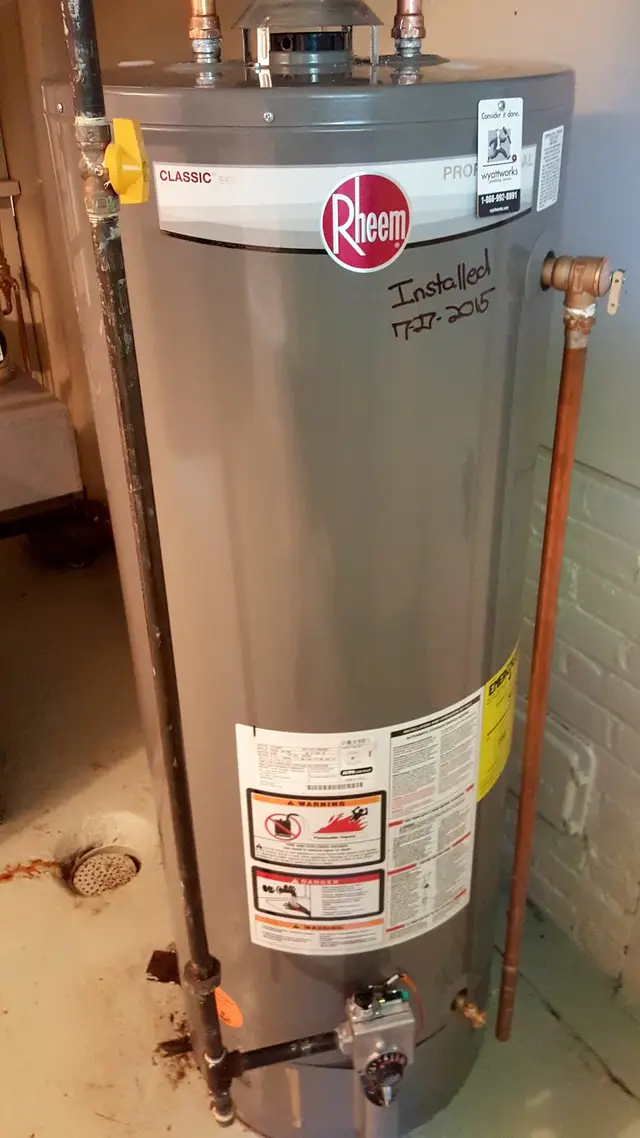
Age sets the default answer before any diagnosis. The rating plate carries a serial number, and most manufacturers encode the build date in it. If the label is unreadable, the permit record or the previous owner's paperwork usually has the year.
| Age of tank | Default position | Reasoning |
|---|---|---|
| 0–6 years | Repair | Well inside the 8-to-12-year life A.O. Smith cites, and parts cost little against a replacement. |
| 7–9 years | Repair the component, plan the replacement | One failure at this age usually means others are queued behind it. |
| 10–12 years | Replace unless the fault is trivial | At the top of the stated life. A repair here buys time, not years. |
| 13 years or more | Replace | Running a pressure vessel full of hot water past its design life in an occupied building. |
| Any age, tank shell leaking | Replace | A weeping tank is a corrosion failure. There is no repair for it. |
Reading the symptom, not just the age
Age sets the default. The symptom tells you whether the default holds, because some faults are ordinary components and others are the tank itself telling you it is finished.
No hot water at all
On a gas unit this is usually ignition: thermocouple, igniter or gas valve. Angi's repair data puts a thermocouple replacement at about $150 and a gas control valve at about $350. On an electric unit it is usually the upper element or the high-limit cut-out, and a tripped high-limit has a cause worth finding. None of these are tank failures, so on a unit under ten years old they are ordinary repairs.
Hot water runs out too fast
This is rarely a fault. It is either a mismatch between capacity, recovery rate and how the household actually draws water, or a broken dip tube letting cold water short-circuit to the outlet, or sediment occupying the bottom third of the tank. Angi lists the dip tube part at $25. Sediment in an old tank is not a repair.
Rusty or metallic-smelling hot water
Rust in the hot supply only, with the cold running clear, points at the tank interior or a consumed anode rod. If a new anode rod fixes the color, the tank had life left in it. If it does not, the glass lining is gone and the steel is exposed.
Rumbling, popping or kettling
That is water flashing to steam under a sediment layer, or scale breaking loose. It is the sound of a tank that has been running hot for a long time. A flush may quieten it. It does not undo the metal fatigue that produced it.
Water around the base
Trace it before assuming the worst. It may be relief valve discharge, a condensate line, a loose supply connection or a leaking drain valve, all of which are fixable. If the tank seam or shell is weeping, the decision has already been made for you.
Is a leaking water heater dangerous?
A slow weep from the shell is not an immediate safety hazard, but it is a one-way trip. Corrosion does not reverse, and small leaks become large ones without giving notice.
The dangerous leak is a different one. If the temperature and pressure relief valve is discharging, the tank has reached either its temperature or its pressure limit and a safety device is dumping energy to prevent something worse. That is not a valve to cap, plug or swap without finding out why it opened. A stuck thermostat, a failed high-limit, or a closed system with no expansion tank will all do it.
The other risk is water rather than steam. A 50-gallon tank that opens up releases its contents plus whatever the supply keeps feeding in until someone closes a valve. Angi puts water damage repair at $1,300 to $5,550 on average, which on most jobs exceeds the appliance that caused it. A tank sitting above finished floor or in an upstairs closet deserves a pan, a drain to somewhere useful, and a leak sensor.
- Know where the cold-water shutoff for the heater is, and check that it actually turns, before you need it.
- Know where the main shutoff is too. A seized heater isolation valve is common on older installations.
- A gas heater needs the gas valve closed before draining; an electric one needs the breaker off first, or the elements burn out dry.
- Never plug, cap or leave a relief valve discharging into a closed container. The discharge pipe must run downhill to a visible, safe termination.
Can a water heater explode if it is turned off?
The honest answer is that a tank rupture needs two things at the same time: continuing heat input and a relief path that has failed. Turn the heat input off, with the gas valve closed or the breaker off, and thermal runaway has nothing to run on. The realistic failure mode on a heater that is off is a leak, not a rupture.
With the heat on it is different, and the mechanism is worth understanding because it explains why one component matters so much. Water at 212°F and atmospheric pressure is steam; inside a pressurized tank it stays liquid well above that. If a thermostat fails closed and the relief valve is stuck or has been capped, the tank keeps heating superheated water until the shell fails. At that instant the pressure drops and the whole volume flashes to steam at once. That is the entire mechanism.
Recorded ruptures are rare, and they are nearly always the same story: a disabled or seized relief valve combined with a failed temperature control. Both are findable during an ordinary service visit, which is the practical takeaway rather than any statistic.
How long it takes for hot water to come back
For a standard tank with a working heat source, a full reheat from cold is roughly 30 to 40 minutes on a 40-gallon gas unit and roughly an hour to 80 minutes on a 40-gallon electric one. Gas is faster because a burner delivers more energy into the water than a pair of electric elements.
That is full recovery from cold. In practice usable water arrives sooner, because a tank stratifies: hot water collects at the top and is drawn from the top, so the first showers-worth is ready well before the whole volume is up to temperature.
If recovery is much slower than that, the usual causes are sediment insulating the burner, a failing lower element on an electric unit, a thermostat set low, or a gas supply not delivering the input the appliance is rated for. A tankless unit has no recovery period at all, which is a genuine advantage; the trade is a flow-rate ceiling in place of a volume ceiling.
Putting the two numbers next to each other
Angi's 2026 data puts the average water heater repair at $615 across a $90 to $1,800 range, and full replacement at $881 to $1,826 nationally. Those bands overlap heavily, which is the whole point: at the top of the repair range, on an old tank, repair stops making sense arithmetically as well as practically.
- Repair a unit under seven years old when the fault is a component: element, thermostat, thermocouple, gas valve, dip tube or anode rod.
- Replace at any age if the tank shell itself is leaking. There is no repair for a corroded pressure vessel.
- Replace rather than repair once the quoted repair passes roughly half the installed replacement figure on a unit over eight years old.
- Weigh the cost of the second failure. A tank needing one repair at ten years will usually need attention again inside two winters.
- Factor the flood exposure of the location, not only the appliance. The same failure costs very different amounts in a basement with a floor drain and in a first-floor laundry closet.
What to work out before anyone is called
Five minutes of looking changes the conversation, because it turns a vague complaint into a diagnosis someone can price.
- Find the rating plate and work out the build date from the serial number.
- Establish whether water at the base is coming from the tank shell, a fitting, the relief valve or the drain valve.
- Look at the relief valve discharge pipe. It should be full-size, run downhill, and terminate where it can be seen. Capped or plumbed uphill is a defect to fix regardless of everything else.
- Check whether the system has a thermal expansion tank. On a closed system without one, pressure spikes on every heating cycle.
- Note the symptom precisely: no hot water, not enough, too slow to recover, discolored, or noisy. The symptom narrows the diagnosis further than the age does.
- Ask for the repair figure and the installed replacement figure in the same visit, so the comparison is real rather than sequential.
When to put the wrench down
- Discolored water that persists after the anode rod has been dealt with, which points at the tank lining rather than the rod.
- The tank shell or a seam is weeping. That is a replacement, and it is better scheduled than waited out.
- Anything involving the gas line, the vent or the electrical circuit. Colorado licenses plumbers at state level, while the permit and the contractor license are local.
- The relief valve is discharging, or has discharged and nobody knows why. The cause has to be found before the valve is touched.
- Any gas smell, soot, scorching at the draft hood, or a pilot that will not hold. That is a combustion and carbon monoxide question, not a plumbing inconvenience.
How Colorado handles this
Front Range water is generally hard, which is the main reason Colorado tanks tend to land at the lower end of the 8-to-12-year life A.O. Smith cites. The long heating season matters too: a heater in an unconditioned crawl space or garage works harder for more months of the year and its standby losses run for longer. Individual plumbers are licensed by the Colorado State Plumbing Board at DORA, while contractor licensing and permits are handled locally, so both need checking. The 2021 IPC and 2021 IFGC apply as the Colorado Plumbing Code (3 CCR 720-1), and local amendments can only be stricter. Water Heater Repair in Colorado is covered in full on its own page, with published ranges on the water heater repair costs page, and requests from any of the 37 covered markets reach licensed plumbers in Colorado. Local pages include Denver and Colorado Springs.
Answers first
Frequently asked
How long does a water heater last in hard water?
Shorter than the label suggests. A.O. Smith gives 8 to 12 years for a tank and names hard water as the main threat to tankless heat exchangers. Scale insulates the bottom of a gas tank so the burner heats through mineral rather than water, and it buries the lower element in an electric tank. Annual flushing and a live anode rod recover most of that gap.
Is a leaking water heater dangerous?
A weep from the shell is a water-damage problem rather than an immediate safety one, and it never improves. A discharging relief valve is different: the tank has hit its temperature or pressure limit and a safety device is venting. That needs diagnosis, not a replacement valve. Any leak near a gas burner assembly or an electrical junction box should be isolated straight away.
Can a water heater explode if it is turned off?
A rupture needs continuing heat input and a failed relief path at the same time. With the gas valve closed or the breaker off there is no heat input, so the realistic failure on a heater that is off is a leak. The mechanism people have in mind is superheated water flashing to steam when the shell fails, and it requires a stuck thermostat plus a disabled relief valve.
How long does it take for hot water to come back after a shower?
On a working 40-gallon gas tank, full reheat from cold is roughly 30 to 40 minutes; on a similar electric tank, an hour or more. Usable water arrives sooner than that because the tank stratifies and draws from the top. Recovery much slower than this usually means sediment, a failing element, a low thermostat setting or a gas supply problem.
Does flushing an old tank do any good?
It helps a tank that has been maintained and does little for one that has not. Angi puts tank flushing at $110 to $200. On a heater that has never been flushed, years of baked sediment often will not pass through the drain valve, and disturbing it can jam the valve open or closed. Flushing is worth doing annually from new. It is not a rescue for a twelve-year-old tank.
Is a water heater warranty worth claiming on an older unit?
It is worth checking before paying for anything. Tank warranties commonly run 6 to 12 years depending on model and are often tied to registration and professional installation, and the paperwork usually covers the tank rather than the labor to swap it. A covered tank still leaves an installed cost to pay, so compare the claim route against Angi's $881 to $1,826 national replacement band before deciding.
Does PlumberColorado charge homeowners anything?
No. PlumberColorado may be compensated by a partner when a homeowner connects with a professional through the site. That never changes what the contractor charges for the job.
Does calling create any obligation to hire?
None. A call or a callback request is a conversation, not a contract. Scope, timing and price are only agreed if you decide to proceed with the professional handling Colorado.