Answer up front
Cutting to the chase: Sewer line work is priced by the foot, by the depth, and by what sits on top of the pipe. Angi's 2026 data puts replacement at $1,388 to $5,323 for most jobs with a $3,319 average, or $50 to $250 per linear foot, and its Denver page reports $2,364 to $6,098 around a $4,231 average. Trenchless is usually less disruptive and not always possible. The lateral is nearly always the homeowner's to pay for.
If you only read one paragraph: Sewer line replacement cost by method and per linear foot, who owns the lateral, and when trenchless lining or bursting is the wrong tool.
Who owns the pipe, and who therefore pays
The sewer lateral is the pipe running from the building to the public main. In most jurisdictions the property owner owns and maintains all of it, and all of it frequently includes the portion under the sidewalk, the strip beyond it, and part of the street, up to the point of connection at the main. The municipality owns the main.
That boundary is the single most consequential fact in a sewer quote. A defect two feet inside the property line and a defect twenty feet out under the street are the same repair with wildly different excavation, permitting and traffic-control costs. The boundary is set locally, so it has to be confirmed with the utility serving the address rather than assumed from what a neighbor was told.
Homeowner insurance generally does not cover a buried lateral failing from age, roots or settlement, because that is maintenance rather than a sudden event. Some utilities offer a service-line protection product, and some cities operate cost-sharing arrangements for the portion in the public right of way. Both are worth checking before authorizing work rather than after.
What sets the number
Two houses on the same street can receive quotes differing by a factor of three. The pipe is rarely the reason. Depth, length and surface do most of the work.
- Length of the run. Angi's trenchless data is banded by length: $1,500 to $8,750 for 25 to 35 feet, rising to $4,500 to $25,000 for 75 to 100 feet.
- Depth. Excavation cost climbs faster than depth does, and past a certain point shoring becomes a requirement rather than a choice.
- What sits on top: lawn, mature trees, a driveway, a sidewalk, a street, or an interior concrete slab. Angi puts concrete slab work at $300 to $350 per linear foot against $50 to $200 per linear foot for ordinary excavation.
- Whether a usable cleanout exists. HomeGuide puts a sewer cleanout at $500 to $2,000, and without access some methods are simply unavailable.
- Number of bends, material transitions and tie-ins. Angi lists tie-ins at $60 to $250 each plus excavation.
- Permits, inspections and utility locates. Angi's Denver page puts permits, inspections and fees at $400 to $1,000, and its trenchless guide says up to $1,000.
Published ranges, and why they disagree so much
Published guides disagree on this job more than on almost any other, and the disagreement is informative rather than sloppy. The same phrase covers a spot repair on a shallow lawn run and a full replacement under a street.
| Method or item | Published figure | Source |
|---|---|---|
| Replacement, typical range | $1,388–$5,323, average $3,319 | Angi, 2026 data |
| Replacement, full span | $225–$10,000 | Angi, 2026 data |
| Replacement, national average | $6,000, span $500–$20,000 | HomeGuide, 2026 |
| Replacement, per linear foot | $50–$250, average $150 | Angi and HomeGuide, 2026 |
| Trenchless, overall | $1,900–$6,000, average $2,900 | Angi, 2026 data |
| Cured-in-place lining, per linear foot | $90–$250 | Angi, 2026 data |
| Pipe bursting, per linear foot | $60–$200 | Angi and HomeGuide, 2026 |
| Open-cut excavation, per linear foot | $50–$200 | Angi, 2026 data |
| Repair rather than replacement | $150–$3,800 | HomeGuide, 2026 |
| Camera inspection | $100–$500, or $175–$350 in the trenchless guide | Angi, 2026 data |
| Denver replacement | $2,364–$6,098, average $4,231 | Angi Denver page, 2026 |
The four methods, plainly
There are four families of approach. The choice is made by the defect, not by preference, and a contractor who explains why the other three were ruled out is telling you something useful.
Per-foot figures are the ones to reason with. A total for the whole job only means something once the length, the depth and the surface are known.
Spot repair
A single defect, such as a cracked hub, one collapsed section or a root entry at one joint, is dug up and replaced over a few feet. Angi puts a cracked pipe repair at $600 to $1,050. This is the least expensive real fix, and it is only appropriate when the rest of the line has been inspected and found sound. A spot repair on a line with six more failing joints is money spent twice.
Cured-in-place lining
A resin-saturated liner is pulled or inverted into the existing pipe and cured, forming a new jointless pipe inside the old one. Angi puts pipe lining at $135 to $150 per linear foot in its trenchless guide and $90 to $250 in its replacement guide. It seals root entry points and cracks along the whole run without a trench, and it reduces internal diameter slightly. It cannot fix shape: a lined belly is still a belly.
Pipe bursting
A bursting head is pulled through the old pipe, fracturing it outward while towing a new pipe in behind. Angi puts pipe bursting with lining at $150 to $190 per linear foot in its trenchless guide, and $60 to $200 in its replacement guide. It needs an access pit at each end and it can install a full-diameter new pipe, but the surrounding ground has to accept the fragments, which rules it out in some situations.
Open-cut excavation
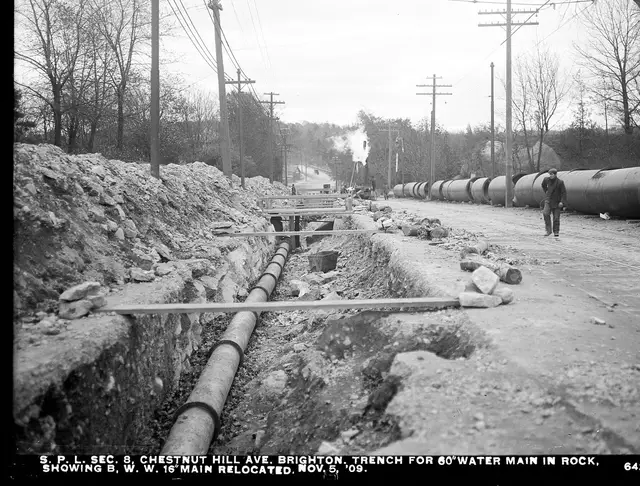
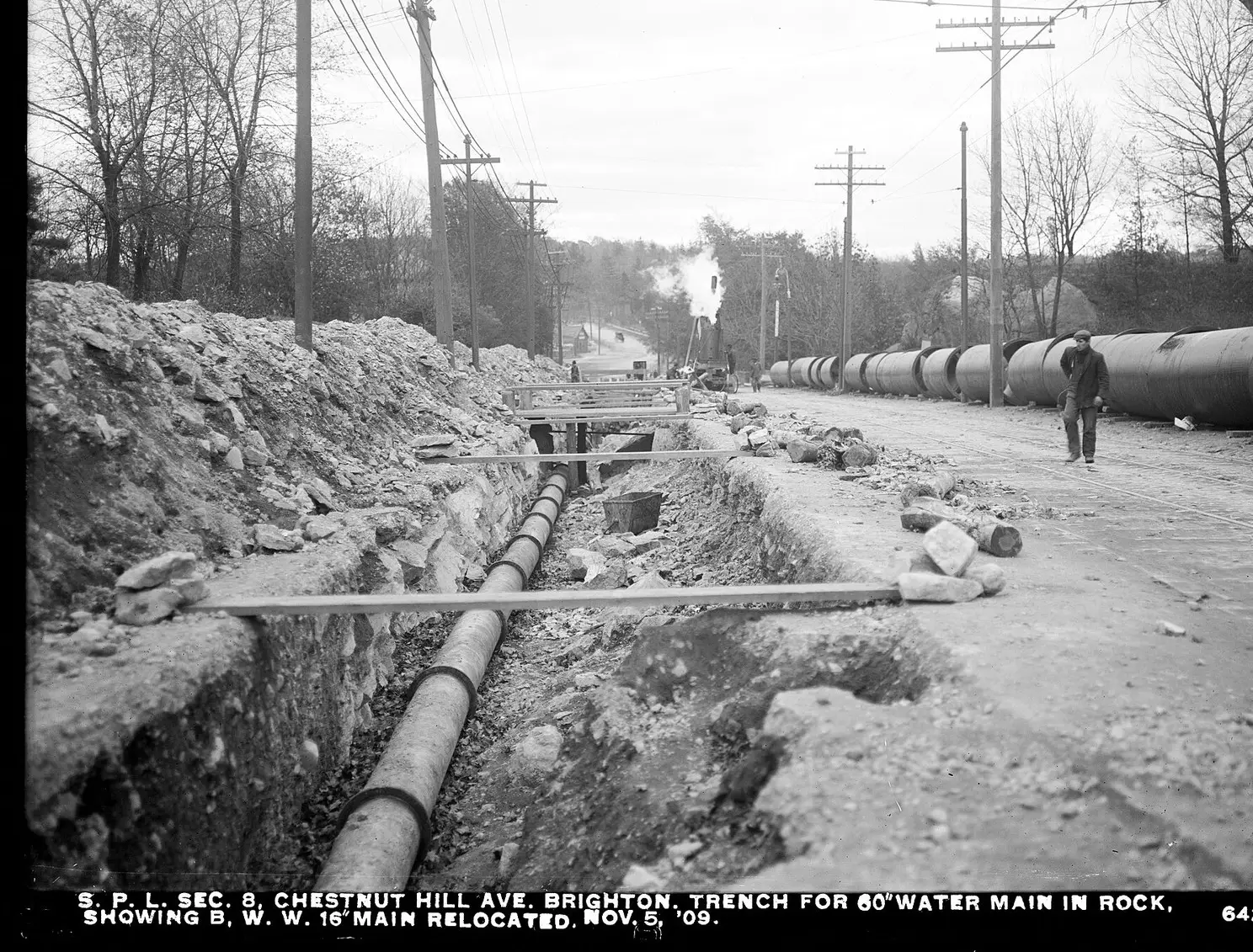
A trench is dug, the pipe is replaced, the trench is backfilled and the surface restored. Angi puts excavation at $50 to $200 per linear foot. It is the only method that can correct grade, remove a belly, change diameter or deal with a fully collapsed line. It is also the method that generates the restoration bill, which is where open-cut quotes diverge from each other.
When trenchless is the wrong answer
Trenchless is often presented as strictly better. It is not. It is a set of tools with a defined envelope, and knowing the envelope is what stops a homeowner paying for a method that preserves the actual problem.
- A belly or back-pitch. Lining follows the existing pipe, so it preserves the sag. Correcting grade means digging.
- A fully collapsed section. There has to be a bore to work through.
- A severe offset joint beyond the liner's tolerance, where the liner cannot bridge the step.
- A change of diameter, if the line is undersized for the fixture count it now serves.
- No usable access at both ends. Bursting needs pits, and lining needs an entry point plus a plan for reinstating branch connections.
- Too many tight bends, or transitions between materials that the method cannot negotiate.
Restoration, permits and the costs that hide there
The excavation is not the end of the job. The surface has to be put back, and that is where an open-cut quote either becomes honest or becomes a change order.
Angi lists yard and driveway repair at $1 to $25 per square foot, a span running from reseeding a lawn to replacing a concrete drive. Slab work inside the building is a different order again, at $300 to $350 per linear foot in the same dataset. Ask exactly what surface restoration is included, to what standard, and whether it covers a street cut where the municipality dictates the patch specification.
Permits sit in the same category. Angi's Denver page puts permits, inspections and fees at $400 to $1,000, its main sewer line clog guide lists sewer permits at $400 to $1,600, and its trenchless guide says up to $1,000. In Colorado those fees are set by the local jurisdiction rather than the state, so the only reliable figure comes from the authority that will issue the permit.
Diagnostics are usually billed separately as well. Angi's Denver page lists a $100 to $250 diagnostic fee covering the first hour and travel. It is reasonable for that to be a charge. It is not reasonable for it to be a surprise.
How to get quotes that can actually be compared
Sequence is what makes quotes comparable on this job. Ask for prices before the line has been surveyed and you will receive numbers priced on different assumptions about the same pipe.
- Get a camera survey with footage markers and a located depth before asking for prices. Without it, every quote rests on an assumption and none of them are comparable.
- Establish where your ownership of the lateral ends by asking the local utility, in writing where possible.
- Ask each contractor for the method, the length being treated, and the price per linear foot as well as the total.
- Ask what is excluded: permits, locates, restoration, the street cut, branch reinstatement and any interior slab work.
- Ask what happens if the line opens up worse than the camera suggested, and get the change-order rule in writing.
- Ask for the warranty on the pipe or liner and on the labor separately, and how it is affected if a defect later appears in an untreated section.
- Verify the individual plumbing license on the DORA register and the contractor license with the local jurisdiction. In Colorado those are two separate checks.
The order to do things in
Order matters here more than on most jobs, because the expensive decisions arrive early and are hard to unwind.
- Confirm the symptom is the main line rather than a fixture branch. Backups at the lowest drain when a large volume discharges are the classic sign.
- Clear the line enough to inspect it if it is blocked. A camera cannot see through standing sewage.
- Camera the full run to the connection, and get the recording.
- Classify the defect: blockage, root intrusion, scale, offset, belly, crack, collapse, or unsuitable material.
- Only then choose a method, because the defect eliminates most of the options on its own.
- Get restoration and permits quoted as separate line items. On a shallow lawn run they are minor; under a driveway they can rival the pipe work.
When to put the wrench down
- Anything requiring a slab penetration inside the building. In much of Colorado that is also a radon-sealing question, because open penetrations give soil gas a path indoors.
- A quote for full replacement issued without a camera inspection. Ask for the footage before authorizing a trench.
- Sewage backing up into the house. That is a health hazard as well as a main-line problem, and it is not a wait-and-see situation.
- Any excavation at all. Utility locates are mandatory, and striking a gas or electrical service while digging for a sewer is the worst outcome available.
- Work in the public right of way or under a street, which brings the municipality's permit, patch specification and traffic control into the job.
How Colorado handles this
Colorado issues permits and contractor licenses locally while individual plumbing licenses come from the state through the Colorado State Plumbing Board at DORA, so a sewer job needs both checked. Denver work goes through Denver Community Planning and Development, while Colorado Springs and El Paso County are both handled by the Pikes Peak Regional Building Department, a single regional authority that is unusual in the United States. Expansive Front Range clay soils and deep seasonal frost move buried pipe, which is why bellies, joint offsets and settlement appear so often in older laterals here. Because much of Colorado sits in EPA Radon Zone 1, any slab penetration opened during the work is the right moment to have it sealed properly. Sewer Line Repair & Replacement in Colorado is covered in full on its own page, with published ranges on the sewer line costs page, and requests from any of the 37 covered markets reach licensed plumbers in Colorado. Local pages include Commerce City and Parker.
Answers first
Frequently asked
Who is responsible for the sewer line, the homeowner or the city?
In most jurisdictions the property owner owns the lateral from the building to the point of connection at the public main, and that often includes the length under the sidewalk and into the street. The municipality owns the main. Because the boundary is set locally it has to be confirmed with the utility serving the address before excavation is authorized, since it decides who pays for the most expensive part of the run.
How much does sewer line replacement cost?
Published bands are wide because the job varies enormously. Angi's 2026 data puts most replacements at $1,388 to $5,323 with a $3,319 average, and its Denver page at $2,364 to $6,098 with a $4,231 average. HomeGuide's national average is higher, at $6,000 across a $500 to $20,000 span. The per-foot figures, $50 to $250 averaging $150, are the more useful comparison once the length is known.
Is trenchless always less expensive than digging?
Not always, but it frequently wins on total cost once restoration is counted. Angi puts trenchless at $1,900 to $6,000 with a $2,900 average, and open-cut excavation at $50 to $200 per linear foot before any surface repair. Under a lawn, digging can be competitive. Under a driveway, a sidewalk or a mature tree, restoration is usually what decides it.
How long does sewer line replacement take?
A spot repair on a shallow, accessible run is often a day. Lining or bursting a full lateral commonly runs one to a few days, with curing time on a cured-in-place liner. Open-cut replacement under a driveway or street takes longer once permits, locates, traffic control and surface restoration are counted. The permitting and inspection sequence, rather than the pipe work, is usually the longest part.
Does a sewer replacement add value at resale?
Partly. Angi's Denver page reports recovery of 35% to 50% of sewer line replacement cost at resale. It reads better as risk removal than as an improvement: a clear camera survey and documented replacement remove a line item buyers use to negotiate, which matters more in older neighborhoods where lateral failure is a known local issue.
Should the whole line be replaced, or just the bad section?
It depends on what the camera shows in the rest of it. Replacing one defect in a line whose remaining joints are failing means paying for mobilization, permits and restoration twice. Angi puts a cracked pipe repair at $600 to $1,050 against $1,388 to $5,323 for replacement, so the spot repair only wins when the survey shows the rest of the run is sound.
Does calling create any obligation to hire?
None. A call or a callback request is a conversation, not a contract. Scope, timing and price are only agreed if you decide to proceed with the professional handling Colorado.
Are night and weekend calls handled differently in Colorado?
Requests route around the clock, but most contractors price after-hours work differently. Ask for the after-hours rate and a committed arrival window before agreeing to a dispatch.