Answer up front
Cutting to the chase: Route by hazard, not by symptom. A gas odor means leaving the building and calling from outside: Xcel Energy's residential gas safety material says to get everyone out, avoid matches, phones, switches, metal tools and engines, and once safely away call 911 and then Xcel at 1-800-895-2999. A ceiling leak means closing the main shutoff, then a licensed plumber. A sewer backup means the municipality first, because Denver's Wastewater Management FAQ states the city is responsible only for main public sewers and will repair and arrange cleanup where the fault is in its own main.
If you only read one paragraph: Which number to dial first for a ceiling leak, a gas smell, a sewer backup or no water at all, and where the municipality's pipe stops and the homeowner's starts.
Three categories, and each gets a different first call
Almost every plumbing panic falls into one of three buckets: something that can hurt people, something actively destroying the building, and something merely broken. The bucket decides who picks up the phone first, and getting it wrong is how a fifteen-minute problem turns into a claim.
Order matters because the parties have different powers. A gas utility can shut and lock a meter. A water utility can close a curb stop when a homeowner's valve refuses to move. A licensed plumber can open a wall. A restoration contractor can dry a structure back to a measured moisture level. None of them can do each other's work, and calling out of sequence spends the one thing in short supply.
- Hazard first. A gas odor, sewage in living space, water near live electrics, or anyone feeling unwell near a fuel-burning appliance.
- Active damage second. Water leaving the plumbing system and entering the building fabric. Stop the flow at a valve, then call a licensed plumber.
- Broken but contained third. A dripping tap, a slow drain, a running toilet. Paying an after-hours premium for these is a choice, not a necessity.
Symptom to first call, in one table
The table below is the short version of this article. It assumes a single-family home on municipal water and sanitary sewer. A private well or septic system changes several rows, because there is no utility to call and the whole system is privately owned.
| Symptom | First call | Then |
|---|---|---|
| Smell of gas indoors or outdoors | Leave, then 911 and the gas utility | A licensed plumber for piping downstream of the meter, once the utility has cleared it |
| Water stain or bulge spreading across a ceiling | No one yet: close the main, then a licensed plumber | Restoration if the cavity is saturated, and notice to the insurer |
| Sewage backing up into a floor drain, tub or basement | The municipal wastewater department | A licensed plumber if the fault sits on the private lateral |
| No water at any fixture in the house | The water utility, to rule out a main break or a closed valve | A licensed plumber if service on the street is normal |
| Water surfacing in the garden, the verge or the street | The water utility | A licensed plumber if the leak is on the homeowner's side of the tap |
| Burst pipe with water running | No one yet: close the main, then a licensed plumber | Restoration, then the insurer |
| Sewage or standing water together with a gas odor | 911 | The utility, then the trades, in that order |
| Relief valve discharging or a soot-marked burner | A licensed plumber, and the gas utility if there is any odor | Repair or replacement, with a permit where required locally |
| Any plan to dig in the garden | 811 | A licensed plumber once the lines are marked |
A gas odor: the call gets made from outside
Natural gas arrives odorless from the ground. The rotten-egg smell is an odorant added deliberately so leaks can be found by nose, which means the smell is the safety system working and should be treated as accurate even when nothing obvious is running.
Xcel Energy's residential gas safety material is direct about sequence. If a leak is suspected, leave the area quickly and do not use anything that can create a spark: no striking a match, no using any phone, no electric switches or appliances, no metal tools, no starting an engine. Only once safely away does the instruction become call 911, then Xcel Energy at 1-800-895-2999. The phone is the part homeowners get wrong, because the handset and the light switch beside it are both ignition sources.
A boundary is buried in that guidance. The same material notes Xcel cannot locate lines owned by others, including customer-installed gas lines. The utility owns up to and including the meter; everything past it is licensed plumbing work.
- Get everyone out, or move upwind and well away if the odor is outdoors.
- Touch nothing on the way: no switches, no garage door opener, no appliance, no vehicle ignition.
- From a safe distance, call 911, then the gas utility's emergency line.
- Wait for the utility. Only it can shut and lock the meter.
- Once the meter is cleared, a licensed plumber takes over customer-side piping and appliance connections.
A wet ceiling: water off first, diagnosis second
A stain on a ceiling is a report filed from somewhere else. Water runs along joists, along the top edge of drywall and down the outside of pipes before it appears, so the wet patch marks where gravity gave up, not where the pipe failed. Investigation is the wrong first move.
Close the main shutoff. If the ceiling sits below a bathroom, that removes a pressurized supply line and a fixture overflow from the list within a minute. If the stain keeps growing with the water off, the source is drainage, the roof or condensation, and the set of trades changes entirely.
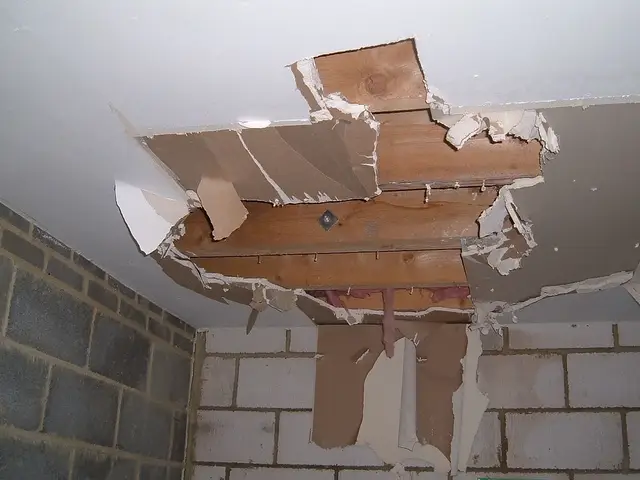
Relieve the load before it drops. A bulging ceiling is holding standing water, and one hole made deliberately over a bucket beats a sheet of soaked gypsum landing on furniture. Angi's 2026 restoration data puts ceiling repair at $450 to $1,600, usually less than the contents underneath. Then call a licensed plumber rather than a drywall contractor: closing a ceiling before the source is found is money spent twice.
- Water off at the main, then open the lowest tap to drain pressure and residual water out of the system.
- Power off to the affected area at the breaker panel before touching a light fitting. Recessed cans sit exactly where water collects.
- Photograph and video the ceiling, the room above and the contents before moving furniture or drying anything.
- Call restoration if insulation, subfloor or carpet is saturated rather than damp. Angi's 2026 figures put water damage restoration at $3,867 on average across a $450 to $16,000 range, with a Denver average of $2,732.
A sewer backup: the municipality answers before the trade
This routing saves the most money and gets skipped the most often. When sewage backs up into a basement floor drain, the fault is either in the private lateral running from the building to the public main, or in the main itself. Only one of those two parties will come out and look at no charge to the homeowner.
Denver's Wastewater Management FAQ states the split plainly: the City and County of Denver is responsible only for main public sewers, and where the problem is in the city sewer line, city personnel will repair it and arrange cleanup where needed. Where the fault is the private line, the FAQ says the homeowner is told as soon as possible and it then becomes their responsibility to contact a plumber. Denver's reporting number is (303) 446-3400.
Read the incentive in that. Calling a plumber first pays for a diagnosis the municipality would have carried out anyway. Other Colorado jurisdictions run the same public-main-versus-private-lateral split under different department names, so the only question is which agency handles sanitary sewer for the address.
- Stop using water anywhere in the house. Every flush adds to what is coming back up.
- Call the municipal wastewater department for the address and report a backup.
- Ask them to check the public main, and ask for the result and a reference number.
- If the main is clear, call a licensed plumber and ask for a camera inspection rather than only a cable clearing, so the cause is identified and not just relieved.
Where the municipality's pipe stops
Two buried lines serve most houses, and the ownership boundary on each is set by published policy rather than intuition. Homeowners tend to assume the property line is the boundary. It usually is not.
Denver Water publishes its dividing point explicitly: the split between utility-owned or distributor-owned mains and the service lines that are the property owner's responsibility sits where the property taps into the main, or at the discharge side of the valve closest to that main. Its material also states the service line is owned by and installed at the expense of the property owner. That puts the entire run beneath the verge and the pavement on the homeowner's side. The meter splits differently again: Denver Water maintains meters that fail through normal wear, while protecting them from mowers, traffic and freezing is the owner's job.
- Water service line: typically private from the tap at the main to the building, including everything beneath the street.
- Sanitary sewer lateral: private, from the building drain out to the connection at the public main.
- Gas: the utility's up to and including the meter, private beyond it.
- Anything to be dug: 811 first. It is the national before-you-dig notification line, and it exists partly because customer-owned buried lines are the ones a utility cannot locate.
Plumbing and restoration are different trades on different clocks
A licensed plumber stops water leaving the system. A restoration contractor stops the building from staying wet. Separate scopes, separate equipment, and treating them as one call delays both halves.
The clock is why both calls get made. Materials that stay wet stop being a drying problem and become a demolition problem. Angi's 2026 data puts mold removal at $1,200 to $3,800 with a $2,225 average, against water damage restoration at $3,867 on average. Much of that gap is how long the water sat before anyone extracted it. One caution: restoration firms often present an authorization to begin work and a direction to pay. Read what is being signed before the equipment comes off the truck.
- A licensed plumber for the pipe, valve, fixture, drain or appliance connection.
- A restoration contractor for extraction, structural drying and moisture readings behind finishes.
- A roofer or drainage contractor if water enters from outside. A plumber will find nothing and still bill for looking.
- The gas utility rather than any trade for anything upstream of the gas meter.
The insurer, and what a 2am call actually costs
Notice and mitigation are the two things a policyholder controls. Policies commonly require prompt notice and reasonable steps to prevent further damage, so the first hour belongs to the water and the documentation rather than a phone queue. This is general information rather than insurance advice; coverage turns on the policy wording in force.
After-hours pricing is real and it is not a trick. Angi's 2026 emergency plumber data reports $100 to $500 per hour with a $170 average, describes emergency work as 1.5 to 3 times standard rates, and splits the premium out as $60 to $300 for an evening, $80 to $400 for a weekend and $120 to $600 for a holiday.
The decision rule is not the multiplier. Ask whether damage is still accumulating. Water entering the building that no valve will stop justifies the premium immediately. If the water is off and nothing is getting wetter, the same repair at eight the next morning costs the daytime rate.
When to put the wrench down
- Anyone feeling dizzy, nauseous or unusually drowsy near a fuel-burning appliance. Treat that as combustion first and plumbing second.
- Any smell of gas, however faint, or a carbon monoxide alarm sounding. Leave first and call from outside; the utility, not a trade, is the first call.
- Sewage standing inside living space. That is a health exposure as well as a plumbing fault.
- Standing water in a room with live electrics, or a wet electrical panel.
How Colorado handles this
Colorado licenses individual plumbers at state level through the Colorado State Plumbing Board at DORA, while contractor licensing and permits are local, so on an emergency call the plumber's state license and the company's local license are two separate checks. Permit authority follows the address: Denver work goes through Denver Community Planning and Development, while Colorado Springs and El Paso County are both covered by the Pikes Peak Regional Building Department. Repeated freeze-thaw cycling and a long heating season put burst supply lines and frozen hose bibb piping high on the list of reasons Colorado homeowners make these calls, and Front Range expansive clays shift buried water services and sewer laterals in ways that raise the ownership boundary question more often than milder, more stable ground would. Emergency Plumbing in Colorado is covered in full on its own page, with published ranges on the emergency costs page, and requests from any of the 37 covered markets reach licensed plumbers in Colorado. Local pages include Castle Rock and Commerce City.
Answers first
Frequently asked
Who do I call for a water leak in the ceiling?
Close the main water shutoff, then call a licensed plumber. The stain is downstream of the failure, so no useful diagnosis happens until the water is off. Add restoration if insulation, subfloor or carpet is saturated rather than damp. Angi's 2026 data puts ceiling repair at $450 to $1,600 and full water damage restoration at $3,867 on average.
Who to call for a gas leak?
Leave the building, then call 911 and the gas utility from a safe distance. Xcel Energy's residential gas safety material says to get everyone out, avoid matches, any phone, electric switches, metal tools and starting an engine, and once safely away to call 911 and then Xcel at 1-800-895-2999. A licensed plumber handles customer-side piping only after the utility has made the meter safe.
Who is responsible for the sewer line, the homeowner or the city?
The split is between the private lateral and the public main. Denver's Wastewater Management FAQ states the city is responsible only for main public sewers, and that where the fault is the private line it becomes the homeowner's responsibility to contact a plumber. Other Colorado jurisdictions apply the same boundary through different departments. That is why the municipal number is the first call on a backup: the city checks its own main before anyone pays to camera a private pipe.
Should the plumber or the restoration company come first?
The plumber stops the water, restoration stops the building being wet, and on a significant loss both get called within the same hour. If only one call is possible, make it the plumber, because water still flowing makes drying pointless. If the leak is already stopped at a valve and the concern is saturated materials, restoration is the more urgent.
Do I need to call the water utility for a leak inside the house?
Not usually. Inside the building the pipe is private, so it is licensed plumbing work. Call the utility in two situations: the main shutoff will not close and the curb stop needs operating, or there is no water anywhere and a main break needs ruling out first.
What does 811 have to do with a plumbing problem?
Everything, the moment a shovel is involved. 811 is the national before-you-dig notification service, and it matters here because sewer laterals, water services and buried gas lines run through the same ground. A utility can only mark what it owns: Xcel notes it cannot locate customer-installed lines, precisely the piping a homeowner is most likely to hit.
How should a plumbing work quote be compared?
Line by line against scope: what is included, what is excluded, who pulls the permit, and whether haul-away and restoration are inside the number. The cost guides on this site list published third-party ranges so any quote can be sanity-checked.
Who handles the permit for plumbing work in Colorado?
The licensed contractor pulls the permit — never the homeowner. If a contractor proposes skipping a required permit, treat that as the signal to stop and verify the license.